
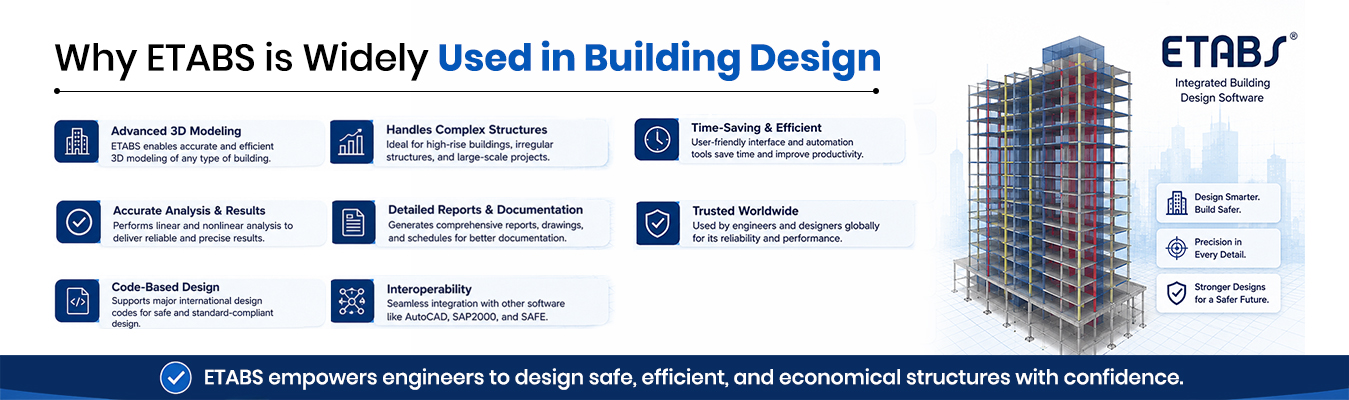
Whenever we talk to almost any structural engineers who work on high-rise buildings, commercial towers or even large residential projects, a single name keeps coming up repeatedly; it is ETABS. Not because of fashion or style but because it truly makes the lives of people who do complex structure design every day easy.
The practice of designing buildings is no longer about simply designing columns and beams. Modern projects have to contend with earthquake forces, wind loads, irregular floor plans, shifting building codes, and constant changes to design. That would be taxing doing all of it by hand, and risky, too.
That's where etabs software became such a trusted tool in the industry.
And honestly, once engineers get comfortable using it, most don’t really want to go back.
A lot of engineering tools can perform structural analysis. But ETABS was created specifically for buildings, and that focus shows in the way the software behaves.
Instead of forcing engineers to “adapt” a generic tool, it already understands typical building elements like:
It's a small thing, but on real projects it saves an unbelievable amount of time.
For instance, if an architect suddenly changes the height of a floor in the 18th floor, and this is more common than you think, engineers can easily update the model without having to rebuild everything from scratch. That is why etabs is so widely accepted in the consulting firms and design offices for those practical advantages.
One reason engineers rely heavily on this software is its ability to simplify complicated calculations.
Tall buildings behave differently under wind and seismic forces. A small modelling mistake can eventually affect safety, cost, and construction timelines. ETABS helps engineers visualize these structural behaviours much more clearly.
Instead of staring at endless spreadsheets, they can actually see:
That visual clarity matters. It turns difficult engineering decisions into something more understandable and manageable.
There’s also a practical side to this popularity. Tight deadlines are common in construction projects, and software that slows teams down simply doesn’t survive long in the industry.
Many engineers prefer etabs software because it helps streamline the workflow from modelling to analysis and design documentation.
Some everyday advantages include:
And perhaps most importantly it reduces repetitive manual work.
No software replaces engineering judgment, of course. But a reliable platform gives engineers more time to actually think about the design rather than fighting the tool itself.
Another interesting thing about ETABS is that even younger engineers tend to pick it up fairly quickly. The interface feels technical, yes, but not unnecessarily intimidating.
Most professionals remember their first few models being messy and confusing. That’s normal. But after working on two or three actual projects, the workflow starts feeling surprisingly intuitive.
CSI Engineering Software Pvt. Ltd. have also contributed significantly by making advanced structural analysis tools more accessible to engineering professionals in India.
Over time, ETABS stops feeling like “software” and starts becoming part of how engineers think through buildings. When an architect proposes a floating floor, a transfer beam, or an unusual geometry, the engineer mentally begins visualising how it would behave inside the model. That’s the kind of confidence good tools create. And with cities growing vertically every year, structural systems are only becoming more complicated. Engineers need tools that can keep up without slowing creativity or precision.
There’s a reason ETABS continues to remain a preferred choice across the structural engineering industry. It combines technical depth with practical usability in a way that genuinely supports real-world building design. From handling seismic analysis to simplifying high-rise modelling, etabs software has earned its reputation through everyday reliability, not marketing hype. And in engineering, reliability always matters more.
CSI Engineering Software Pvt. Ltd. E-169, Lower Ground Floor Greater Kailash -III, Masjid Moth New Delhi-110048
© CSI 2026. All Rights Reserved.
