
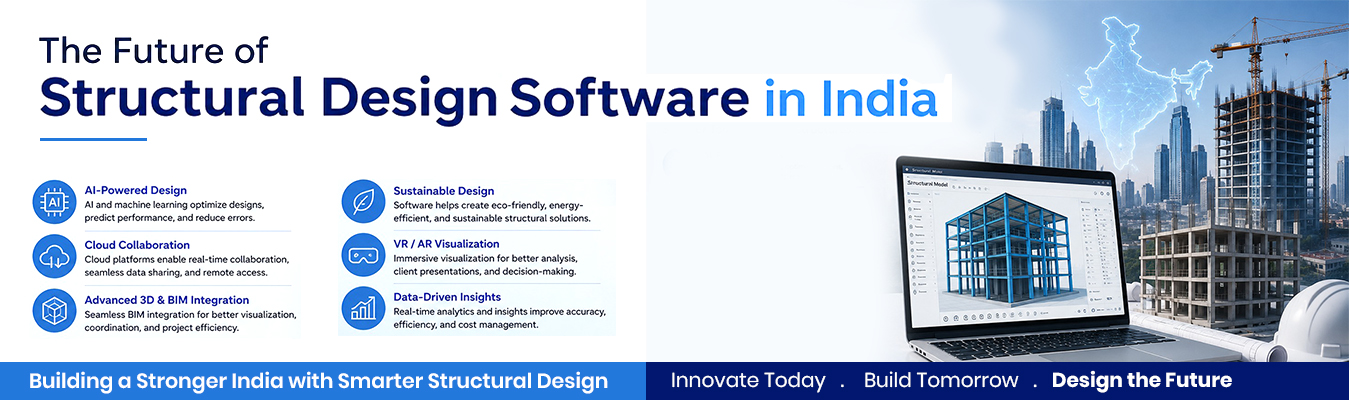
The future of structural engineering software in India is rapidly evolving in terms of project timelines, complex building designs and the ever-increasing need for smart and data-driven decision-making. With the growth of infrastructural development in India and its attendant pressures on the structural engineering and construction industry right now, engineering teams have been utilizing advanced digital tools to assess structures, improve efficiency and minimize the design risk before construction starts.
Structural engineering has always been a profession built on precision. A small design change can influence an entire building system. A revised column layout might affect beam sizes. Material changes can impact loading conditions. What appears minor on paper often creates a chain reaction throughout a project.
Years ago, much of this process relied heavily on manual calculations and repeated checks. Today engineers expect software to handle complex analysis and therefore allow them to make design decisions. That’s a huge change. And truthfully it was likely inevitable.
Construction timelines are tighter than ever. Developers want projects completed faster. Clients expect detailed reporting. Regulatory requirements continue to evolve. At the same time, structures themselves are becoming more complex. A modern engineering team may need to evaluate:
Trying to manage all of that manually would be slow and risky. Modern structural engineering software allows engineers to assess multiple scenarios before construction even begins. That ability to test, compare and refine designs has become one of the industry’s biggest advantages.
The future isn't necessarily about replacing engineers. It's more about giving them better visibility. Several trends are already influencing how design platforms are evolving.
Routine tasks consume valuable engineering time. Future software systems will automate more repetitive tasks and leave key decisions to human beings. Engineers will spend less on data handling and more time on solutions.
Design projects rarely involve a single discipline. Architects, structural consultants, MEP engineers, contractors, and project management All require coordinated information. More and more software platforms are implementing connected workflows to enhance collaboration.
Now engineering teams have more project data than ever. Future systems will likely be able to identify design patterns, surface risks earlier and provide richer analytical insights that help deliver better project outcomes.
If there's one trend that stands out, it's the growing emphasis on optimization. No client wants unnecessary material costs. No engineer wants safety compromises.
The goal is finding the right balance. Modern software helps design teams evaluate alternatives quickly. The structure can be analysed, modified, and re-assessed repeatedly before the first foundation has been laid. This was never possible before. For large infrastructure projects, those improvements can add up to big savings and better long-term performance.
Construction and infrastructure in India continue to grow at an exponential rate. Metro rail, commercial development, manufacturing facilities, renewable energy projects, smart city initiatives all depend on complex engineering support.
The use of sophisticated structural engineering software in India is likely to grow further in the years to come. As clients demand more accuracy, faster turnaround and detailed project documentation, engineering companies are investing more and more in technology. Software is becoming less of a competitive advantage and more of a professional necessity.
With projects becoming more challenging and expectations rising, structural engineering software in India will continue to be at the core of designing safe, efficient and innovative structures. The technology will keep evolving, but the aim is the same: to help engineers build with more confidence and clarity.
It helps engineers analyse, design, and evaluate buildings, bridges, industrial facilities, and other structures while meeting safety and design standards.
It improves accuracy, reduces manual calculations, supports code compliance, and allows engineers to evaluate multiple design options efficiently.
No. Software assists with analysis and calculations, but engineering judgement, design decisions, and professional responsibility remain with qualified engineers.
CSI Engineering Software Pvt. Ltd. E-169, Lower Ground Floor Greater Kailash -III, Masjid Moth New Delhi-110048
© CSI 2026. All Rights Reserved.
