
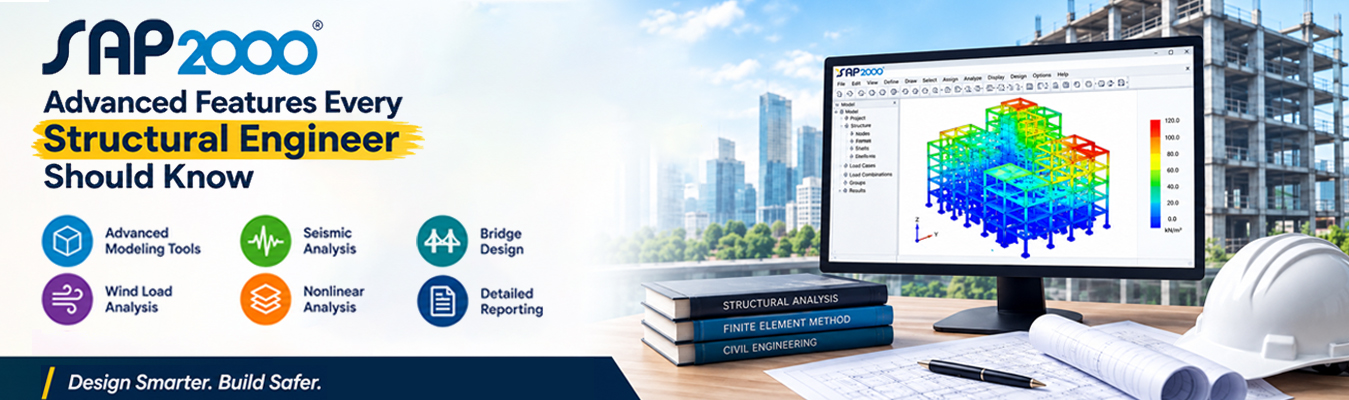
Structural engineers rarely deal with simple projects anymore. Irregular buildings, complex load conditions, seismic requirements and tight project timelines are now fairly common. This is where SAP2000 becomes particularly useful, giving engineers tools to model, analyse and understand structural behaviour before construction begins.
For professionals who already know the basics, the real value lies in its advanced capabilities. Nonlinear analysis, P-Delta effects, staged construction, response-spectrum analysis and time-history analysis can provide a much deeper picture of how a structure may behave under different conditions.
Some features deserve particular attention because they can make structural analysis more detailed and practical:
Not every project needs every feature. Knowing when to use them is the important part.
P-Delta effects can become significant when structures are subjected to substantial vertical loads and lateral movement. In simple terms, the existing deformation of a structure can influence how it responds to additional loading.
The software allows engineers to account for these geometric effects during analysis. This can be particularly relevant for taller or more flexible structures, where lateral displacement deserves closer attention.
CSI’s documentation also highlights P-Delta analysis as part of its nonlinear analysis capabilities.
Real structures do not always behave in a perfectly linear manner. Materials can yield, members can experience large deformation and stiffness can change as loading increases.
Nonlinear analysis allows engineers to study such behaviour rather than assuming everything remains within a simple elastic response.
This becomes useful when assessing:
For projects where understanding actual structural behaviour matters, this additional level of analysis can be extremely valuable.
A building does not appear fully formed overnight. It is constructed in stages, and the sequence can affect how loads and stresses develop.
The staged-construction capability allows engineers to add or remove structural components and apply loads according to construction sequences. It can also account for time-dependent effects such as creep and shrinkage.
This is particularly helpful when the construction sequence itself is an important part of the structural problem.
Both methods are used for dynamic structural analysis, but they answer slightly different questions.
Response-spectrum analysis provides an efficient way to estimate likely structural response to seismic loading based on ground-acceleration characteristics. Time-history analysis, meanwhile, studies structural response step by step against a specified ground motion or other time-varying load.
Engineers can therefore select the approach based on the project's analysis requirements rather than treating seismic loading as a one-size-fits-all problem.
Buckling isn't simply about whether a member suddenly bends. In many cases, stiffness changes as loading increases, making the actual response more complicated.
Nonlinear buckling analysis can consider geometric and material nonlinearities while the load is applied incrementally. That can provide a more realistic understanding of structural stability than a basic linear approach.
Advanced analysis is useful only when it helps an engineer make a better decision.
The real advantage is the ability to investigate different structural conditions before they become construction problems. Engineers can compare scenarios, examine critical responses and make informed design changes while the project is still on the computer.
CSI Engineering Software Pvt. Ltd. supports engineering professionals with access to structural analysis and design software, helping them work with tools suited to increasingly complex projects.
Advanced analysis features can help structural engineers understand nonlinear behaviour, seismic response, stability and construction-stage effects more closely. The right feature depends on the structure, loading and design objective.
Is SAP2000 useful for complex structures?
Yes. It supports advanced static, dynamic and nonlinear analysis for complex structural problems.
When is P-Delta analysis useful?
It is useful when structural deformation can significantly influence the response.
Can staged construction be modelled?
Yes. Construction stages, load application and time-dependent effects can be modelled.
Can seismic response be studied?
Yes. Response-spectrum and time-history analysis are available for dynamic studies.
Does advanced analysis replace engineering judgement?
No. Software results still need professional interpretation and engineering judgement.
CSI Engineering Software Pvt. Ltd. E-169, Lower Ground Floor Greater Kailash -III, Masjid Moth New Delhi-110048
© CSI 2026. All Rights Reserved.
