
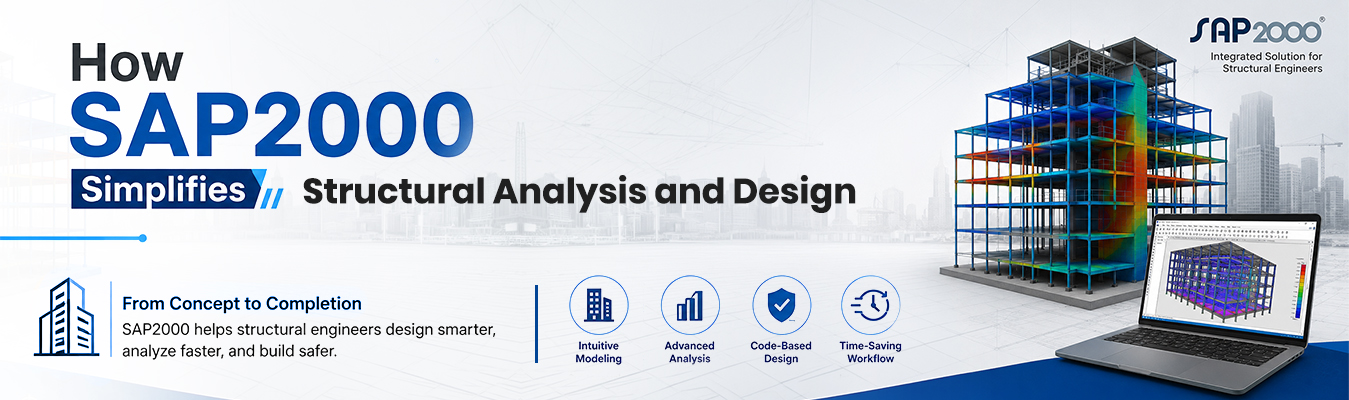
SAP2000 pulls modeling, analysis, and code-based design into one continuous workflow, cutting out the back-and-forth engineers used to deal with when juggling separate tools for structural analysis and design. Whether it's a simple footbridge or a full-blown industrial structure, the software takes on the heavy computational work, leaving engineers free to focus on the actual design calls instead of grinding through hand calculations. That’s part of why SAP2000 software is still the go-to for bridges, towers, stadiums and just about anything that doesn’t fit neatly into a typical building box.
Most engineers don't switch tools because a new one has flashier graphics. They switch because a tool actually saves time on the parts that used to eat up entire days. SAP2000 fits that description for a lot of firms, mainly because it wasn't built around one structure type. It’s not just about buildings, it’s about bridges, stadiums, offshore structures, anything with unusual geometry that doesn’t force engineers to find workarounds.
That flexibility is really the key reason SAP2000 structural design software gets the call for projects that don’t fit a standard mould.
1. General-Purpose Modeling for Any Structure Type
Unlike building only tools, SAP2000 works equally well for bridges, stadiums, towers or industrial frames. The engineers don’t need to adapt a tool designed for buildings to an unusual structure.
2. Integrated Analysis and Design in One Workflow
Once the model's built, SAP2000 runs the structural analysis and moves straight into code-based design checks (steel, concrete, aluminium, whatever the project calls for) without needing to export anything into a separate design tool.
3. Nonlinear and Dynamic Analysis Capabilities
Complex load conditions, seismic behaviour, and time-history analysis are all handled within the same environment. For structures where standard linear analysis just isn't enough, this saves engineers from juggling multiple software licenses.
4. Bridge-Specific Modeling Tools
SAP2000 includes dedicated bridge modeling features, from parametric bridge geometry to moving load analysis, which makes it genuinely useful for transportation infrastructure projects, not just an afterthought bolted onto building-focused tools.
5. Automated Code Checks Across Regions
Design checks against IS codes, AASHTO, Eurocode, and several others come built in, which matters a lot for firms working across multiple countries or handling projects with varying regulatory requirements.
Not always. Some engineers still prefer tools built specifically around that use case for simple multi-storey buildings. But for anything outside of the typical building box like bridges, industrial structures, unusual geometries, SAP2000 tends to be a lot less friction than adapting a building-specific tool.
SAP2000 simplifies structural analysis and design by pulling modeling, analysis, and code checks into one continuous process, saving engineers from the back-and-forth that used to slow projects down. Its flexibility across bridges, towers, and unconventional structures is really what sets it apart from tools built for a single structure type. CSI Engineering Software Pvt. Ltd. continues to support engineers working with SAP2000 software, helping teams get real value out of the tool rather than just using a fraction of what it's actually capable of.
1. What is SAP2000 mainly used for?
It's used for structural analysis and design across a wide range of structures, including buildings, bridges, towers, and industrial frameworks.
2. Can SAP2000 handle bridge design specifically?
Yes, it includes dedicated bridge modeling tools, parametric geometry options, and moving load analysis suited for transportation infrastructure.
3. Does SAP2000 support Indian design codes?
Yes, along with IS codes, it supports several international standards like AASHTO and Eurocode, depending on the project's location.
4. Is SAP2000 suitable for nonlinear analysis?
Yes, it handles nonlinear and dynamic analysis, including seismic behavior and time-history analysis, within the same modeling environment.
5. Is SAP2000 difficult to learn for engineers new to structural software?
It has a learning curve like most engineering tools, but its general-purpose approach makes it adaptable once engineers get comfortable with the basic workflow.
CSI Engineering Software Pvt. Ltd. E-169, Lower Ground Floor Greater Kailash -III, Masjid Moth New Delhi-110048
© CSI 2026. All Rights Reserved.
