
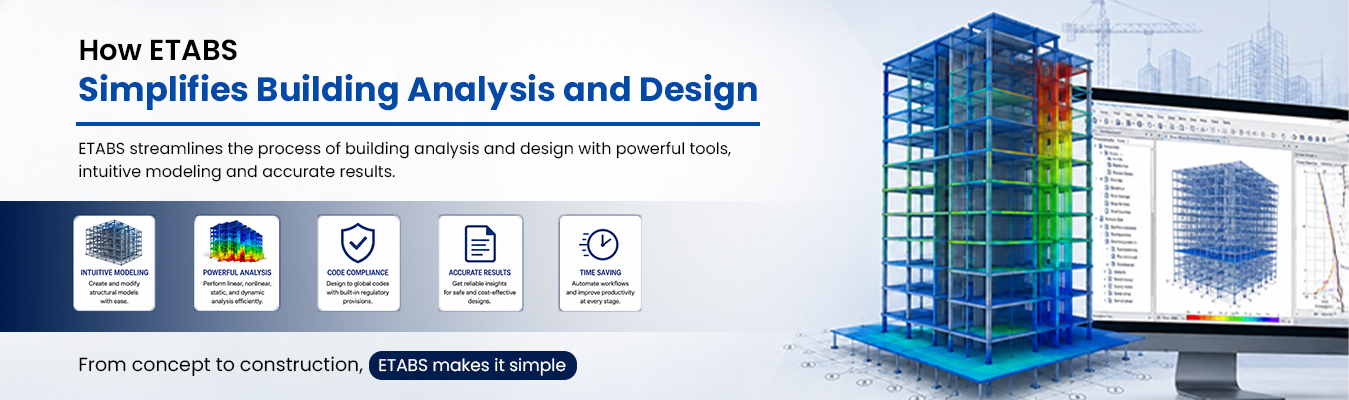
In the construction process, a building rarely begins with concrete and steel. It usually begins with calculations. Hundreds of them. Load paths, structural behaviour, wind effects, seismic forces are things most people never see but that determine whether a structure works decades later.
The problem is that buildings are getting more and more complex these days. Architects want longer spans; developers want shorter project timelines and engineers need to balance safety, efficiency and cost all at the same time. That is where ETABS has earned a reputation in structural engineering offices throughout the world.
engineers spend hours a week doing calculations manually, they can evaluate, model and refine building designs in one environment. It provides a faster decision-making process and, most of the time, less surprises later on in the project.
A few decades ago, structural analysis was a lot of spreadsheets, hand calculations and repeated revisions. That was the way that worked for small projects, that approach was good enough Modern high rises, mixed use developments, hospitals and commercial complexes are another matter.
A single design change can affect a lot of structural elements. Change one column size and suddenly beams, slabs and load distributions may need to be reviewed. Managing all of that manually becomes very difficult very quickly. That is why engineers now have to use specialized tools so that they can visualize structural behaviour before construction even starts.
There are many structural engineering programs available, but ETABS was developed for building analysis and design specifically.
That distinction matters.
Instead of thinking of a building as a generic structure, the platform is built around how real buildings are actually designed. Floors, columns, walls, beams and foundations can all be included in one analytical model.
Some of its most widely used capabilities include:
For engineers, this means fewer disconnected workflows and less time spent transferring information between different systems.
One of the biggest advantages of modern structural software isn't speed. It's visibility. Imagine discovering that a beam is overloaded after construction has already begun. The cost implications can be substantial. Delays, redesigns, material changes-none of those are welcome conversations on an active project.
With Etabs software, engineers can identify many of these issues at the design phase itself. The software helps visualize how loads move through a structure and where important areas should be kept in mind before drawings are complete. This early insight often saves significant time and resources later.
Engineering decisions are rarely based on guesswork. They depend on data. A sound analytical model enables engineers to compare different design approaches, evaluate structural performance and optimize material usage while ensuring safety.
For example:
Design teams can assess whether certain members are overdesigned and refine them accordingly.
The detailed analysis of buildings in earthquake risk zones. Correct modelling gives engineers an understanding of how structures may react under seismic conditions.
Project requirements change frequently. Software-driven analysis allows modifications to be tested quickly without restarting calculations from scratch.
In practical terms, this supports better engineering judgement and more efficient project delivery.
There is a reason why Etabs software remains widely used across consulting firms, infrastructure projects, and commercial developments.
The software combines analytical depth with practical usability.
Engineers are able to:
For clients and project stakeholders, that often translates into greater confidence during both the design and construction stages.
That’s why tools like ETABS have become an important part of modern structural engineering. The software helps engineers analyse, refine and validate designs before construction begins, so they can control the process in a much shorter, less time consuming and therefore easier way.
ETABS is a structural engineering software platform used for analysing and designing buildings, including residential, commercial, and high-rise structures.
Yes. The software includes advanced capabilities for seismic analysis, allowing engineers to evaluate building performance under earthquake loading conditions.
It provides detailed structural modelling, load analysis, and performance evaluation, helping engineers make informed design decisions before construction begins.
CSI Engineering Software Pvt. Ltd. E-169, Lower Ground Floor Greater Kailash -III, Masjid Moth New Delhi-110048
© CSI 2026. All Rights Reserved.
