
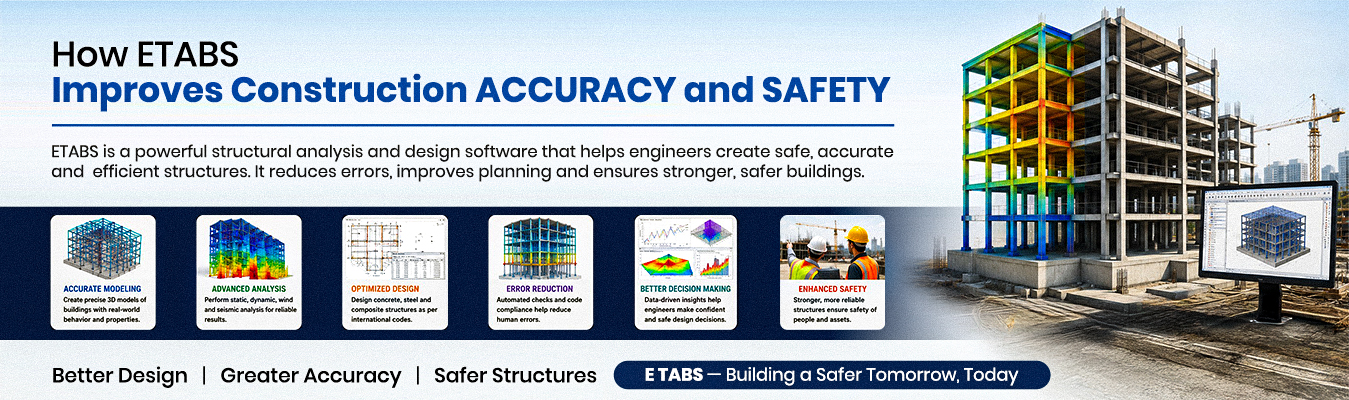
Construction mistakes are expensive. Sometimes painfully expensive. A small calculation error during structural planning can create delays, material wastage, redesign costs, or in serious cases, safety risks that show up years later. That’s exactly why engineers rely heavily on tools like ETABS while designing buildings today.
Manual calculations still matter, of course, but modern projects are far too detailed and fast-moving to depend only on spreadsheets and hand-drawn analysis. For structural engineers working on residential towers, commercial buildings, hospitals, or industrial projects, software-based modelling has become part of everyday work now, not some “extra” feature.
Companies like CSI Engineering Software Pvt. Ltd. have helped make advanced structural analysis tools accessible for engineering professionals looking to improve design precision and project safety standards.
Most people notice the architecture of a building first. Glass facades. Elevation design. Fancy interiors. Engineers notice something completely different.
Load distribution. Structural behaviour. Wind resistance. Earthquake response. Column placement. Foundation stress. That hidden layer is what keeps buildings stable for decades.
The challenge is that modern buildings are no longer simple box-shaped structures. Architects now design curved layouts, irregular elevations, mixed-use towers, and open-span spaces that demand much deeper structural analysis than before. Calculating all of that manually would take forever and the margin for error becomes risky pretty quickly. That’s where etabs software changes the process.
Fundamentally, ETABS assists engineers to digitally design building structures and perform building design analysis before construction starts. Just like a virtual stress test for a building.
Engineers can simulate:
Instead of waiting until construction reveals problems, engineers identify weak points during the design stage itself. This alone saves enormous time and cost later.
One of the biggest advantages of ETABS is precision. Even experienced structural engineers know that large projects involve thousands of interconnected calculations. A tiny oversight in one area can affect the entire structural system somewhere else. Software modelling reduces that risk substantially.
Buildings carry different kinds of loads simultaneously. Occupancy load, equipment load, wind pressure, seismic forces, everything interacts together.
ETABS helps engineers analyse these conditions in combination rather than separately, which creates more realistic structural models.
Architectural changes happen constantly during projects. A floor layout changes. Additional parking gets added. Staircase positioning shifts.
Without software, redesigning structural calculations repeatedly becomes exhausting. ETABS allows engineers to update models quickly instead of restarting calculations from scratch every single time.
Structural teams, architects, and consultants can review detailed models together before execution begins. That collaboration helps reduce on-site surprises later. And decently, fewer surprises during construction usually means fewer headaches for everyone involved.
Accuracy is important. Safety is non-negotiable. A single badly analysed structural component can create long-term vulnerabilities that may not become visible immediately. This is especially the case for earthquake-prone regions, for structural analysis is a vital prerequisite given that buildings experience dynamic forces, not just static weight loads. This is where etabs software becomes particularly valuable.
Engineers can simulate seismic behaviour digitally and evaluate:
That level of analysis helps improve building resilience before construction even starts. Which, when you think about it, is far better than discovering structural weaknesses after occupancy.
Construction timelines are tighter now. Expectations are higher too. Clients want faster project delivery without compromising safety or compliance. Software tools help engineers manage that pressure while maintaining design quality.
A few practical reasons professionals continue using ETABS:
For high-rise and commercial projects especially, software-driven analysis has become standard practice rather than optional support.
ETABS helps structural engineers design safer and more accurate buildings by digitally analysing how structures respond to loads, environmental forces, and design changes before actual construction begins.
No. While it’s widely used for tall structures, engineers also use it for residential, commercial, and institutional projects.
Not at all. The software supports engineering analysis, but professional judgment and design expertise still remain essential.
It helps engineers simulate seismic forces and study how a structure behaves under movement and stress conditions.
CSI Engineering Software Pvt. Ltd. E-169, Lower Ground Floor Greater Kailash -III, Masjid Moth New Delhi-110048
© CSI 2026. All Rights Reserved.
